Demystifying RF Exposure: What My Meters Couldn't Tell Me
August 2026
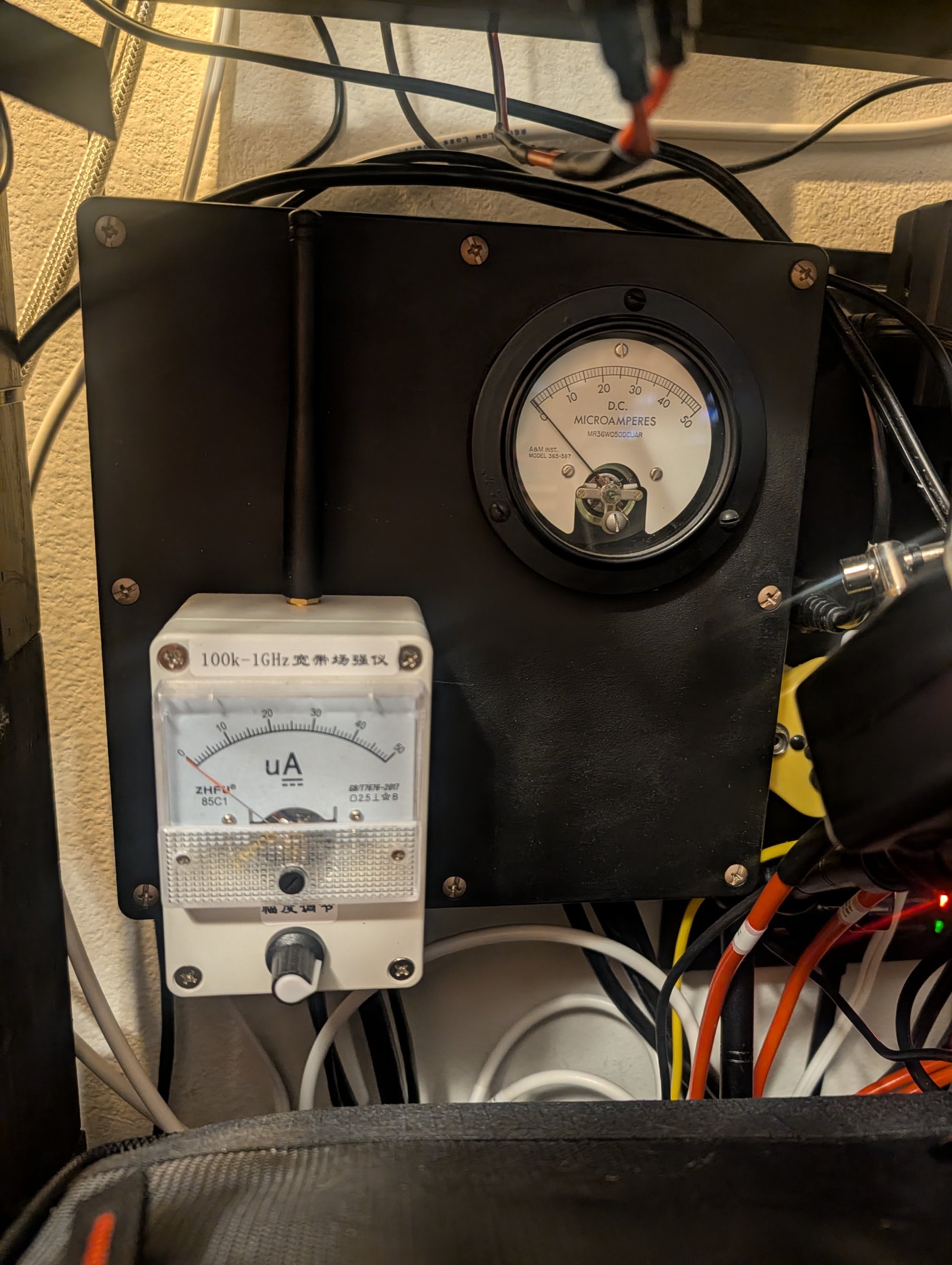
Yesterday morning I was running FT8 on 15 meters, 40 watts — calling a station in the Republic of the Congo, and answering one closer to home who’d come back to me with a report. Routine morning. Then I noticed the needle on one of the meters at my cable entry panel was coming up off zero.
Not far — it wanders between roughly 2 and 6 on a 50 µA scale. But it was moving, and it was moving while I was transmitting.
Hold onto that word “roughly,” because it turns out to matter more than the number does.
Before I was a ham, I had no idea whether that was something to worry about. I didn’t know what RF exposure was, what a safe level looked like, or how anyone would even tell. My guess is a lot of people reading this are in the same place I was — either it’s never come up, or you’ve absorbed a vague sense that radio waves are something to be uneasy about without ever seeing a number.
So I went and got the numbers. Here’s what I found, including the part where I discovered that neither instrument on that panel could actually answer the question.
First, the calculation
There’s a step here a lot of hams skip, or don’t know exists. Since May 2021 the FCC has required every amateur station to evaluate its RF exposure — the old blanket exemption for amateur radio is gone. The transition period ended in May 2023. If you have a station, this applies to you.
The good news is that it takes about fifteen minutes, and the ARRL hosts a free calculator that does the arithmetic.
Here’s my station — the same setup that moved the needle:
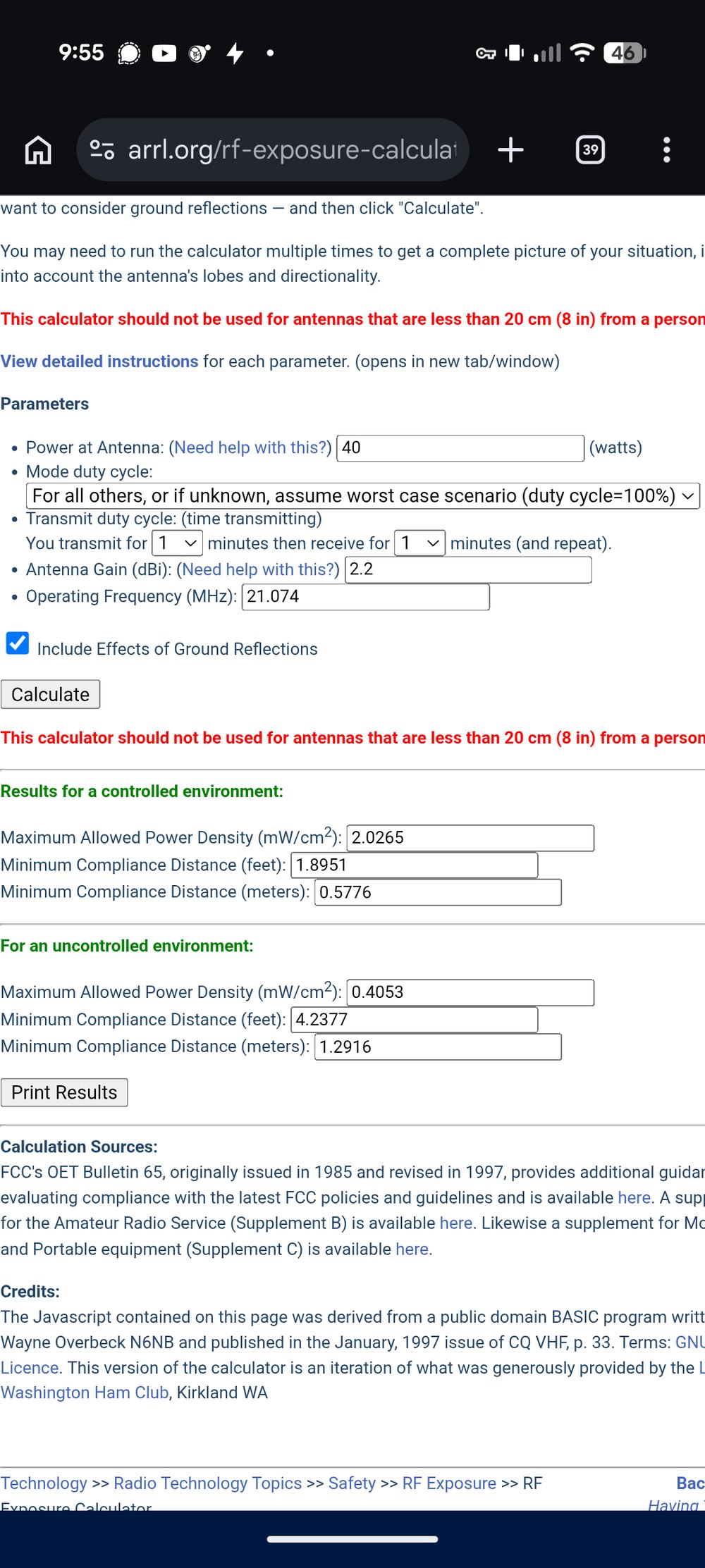
- Power at antenna: 40 W
- Mode duty cycle: 100% (worst case)
- Transmit duty cycle: 1 minute on, 1 minute off
- Antenna gain: 2.2 dBi
- Frequency: 21.074 MHz
- Ground reflections: included
And the answer:
| Maximum allowed | Minimum distance | |
|---|---|---|
| Uncontrolled (neighbors, family, anyone unaware) | 0.4053 mW/cm² | 4.24 ft |
| Controlled (me, aware of the exposure) | 2.0265 mW/cm² | 1.90 ft |
That’s the whole scary thing, demystified: stay about four and a quarter feet from my antenna and everybody is fine. My antenna is sixty feet away in the side yard. I am not close to a problem, and I never was.
I ran those inputs a second time through the underlying FCC formulas from OET Bulletin 65 rather than trusting the calculator’s output. All four numbers reproduced exactly. The arithmetic is sound.
I’ll also say plainly that I used Grok to help work through this. It got the arithmetic right — every conversion and percentage checked out. It also got something important wrong, which is the next section.
Then I tried to actually measure it
I have two meters mounted at my cable entry. Having just calculated a number, the obvious move was to go look at what they said.
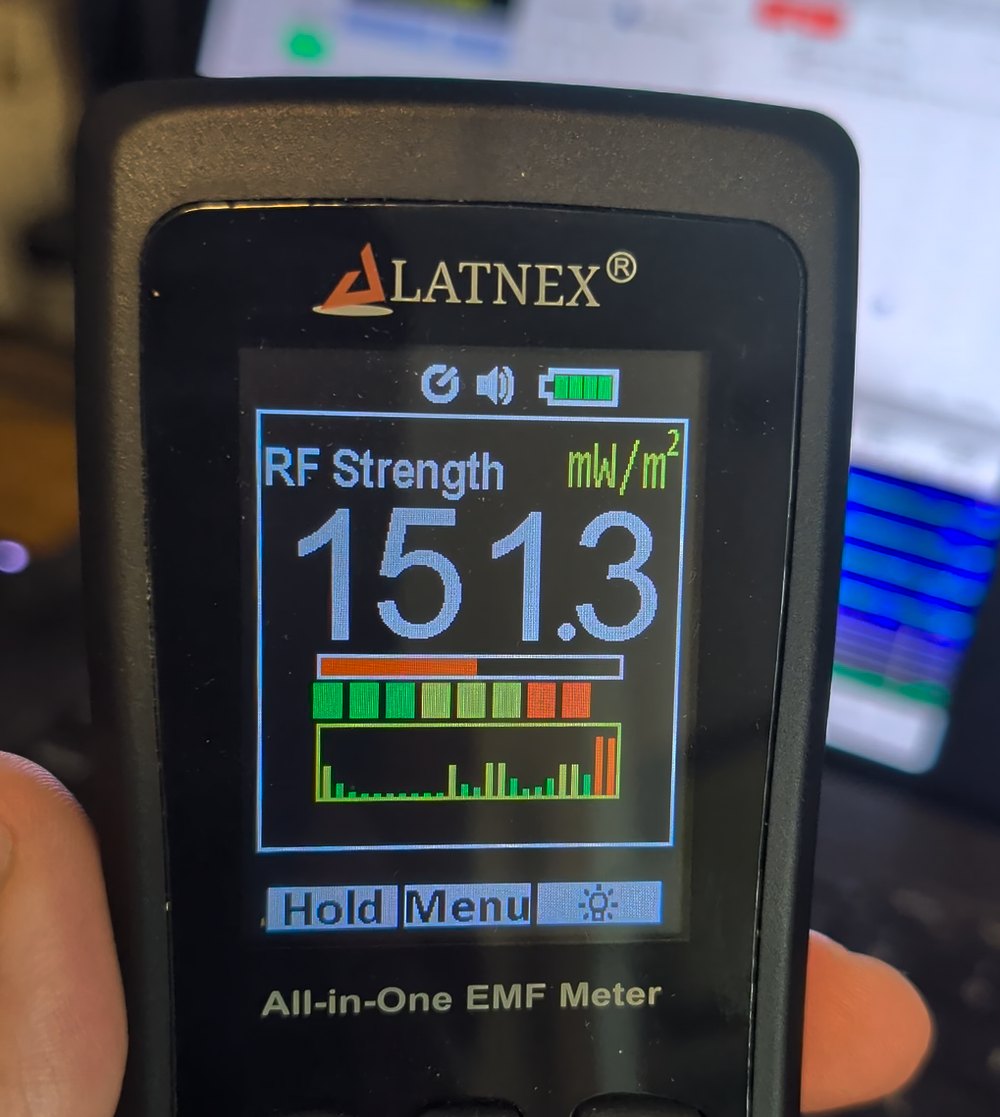
The digital one read 151.3 mW/m². Convert that to the same units as the limit and it’s 0.01513 mW/cm² — about 3.7% of what’s allowed. Comfortable. Done, right?
No. That meter’s RF range starts at 50 MHz. I was transmitting at 21.074 MHz — less than half its lowest usable frequency. Its only published accuracy figure is ±2 dB at 2.45 GHz, which tells you what it was really built for: WiFi, cell phones, smart meters. Exactly the sort of thing most of these consumer EMF meters are designed around.
So that reading isn’t a measurement of my signal. It might be out-of-band response, it might be ambient RF from the house, it might be both. I can’t tell you which, and neither can the meter.
The other meter — the analog one whose needle started all this — covers 100 kHz to 1 GHz, so 21 MHz is comfortably inside its range. But it’s an uncalibrated relative indicator with a sensitivity knob on the front. It can tell you RF is present. It cannot tell you how much.
One instrument was out of band. The other was in band but uncalibrated. Neither could check the calculation.
The part I didn’t expect
I assumed this was a shopping problem — buy a meter with the right frequency coverage and the job’s done.
It isn’t, and the reason is more interesting than the problem.
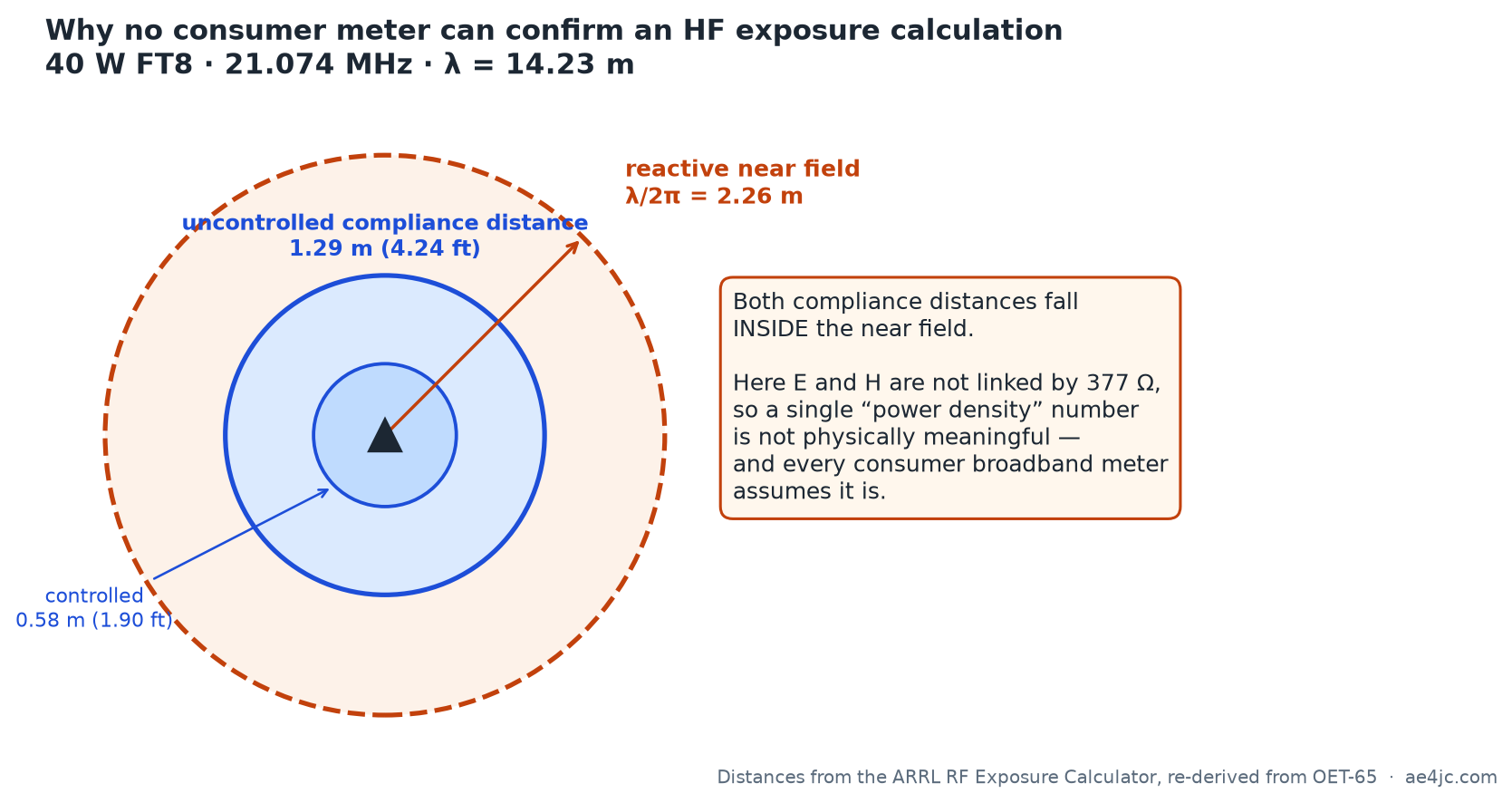
At 21.074 MHz a wavelength is 14.23 meters. The boundary of the reactive near field sits at λ/2π, which works out to 2.26 meters. My uncontrolled compliance distance — the 4.24 feet the calculator told me to check — is 1.29 meters.
It’s inside the near field. So is the controlled distance.
That matters because in the near field, the electric and magnetic fields aren’t tied together by the 377-ohm impedance of free space. “Power density” stops being a single meaningful quantity, and every broadband power-density meter you can buy assumes it is one.
No consumer meter can confirm an HF exposure calculation near your antenna. Not the wrong one I own. Not a better one. The measurement those meters perform isn’t defined at that distance.
The FCC already knew this. For 1.34–30 MHz the rules give three separate limits, not one. At my frequency:
| Quantity | General population limit |
|---|---|
| Electric field | 39.09 V/m |
| Magnetic field | 0.1039 A/m |
| Power density | 0.4053 mW/cm² |
In the near field you check E and H separately, against their own limits. Power density is the far-field convenience.
This is also why compliance for amateur stations is established by calculation, not measurement. That’s not a loophole or a shortcut. Measuring it properly is genuinely hard, and the calculation is the real tool.
So what moved the needle?
Here’s where I have a hypothesis rather than an answer, and I want to be clear about which is which.
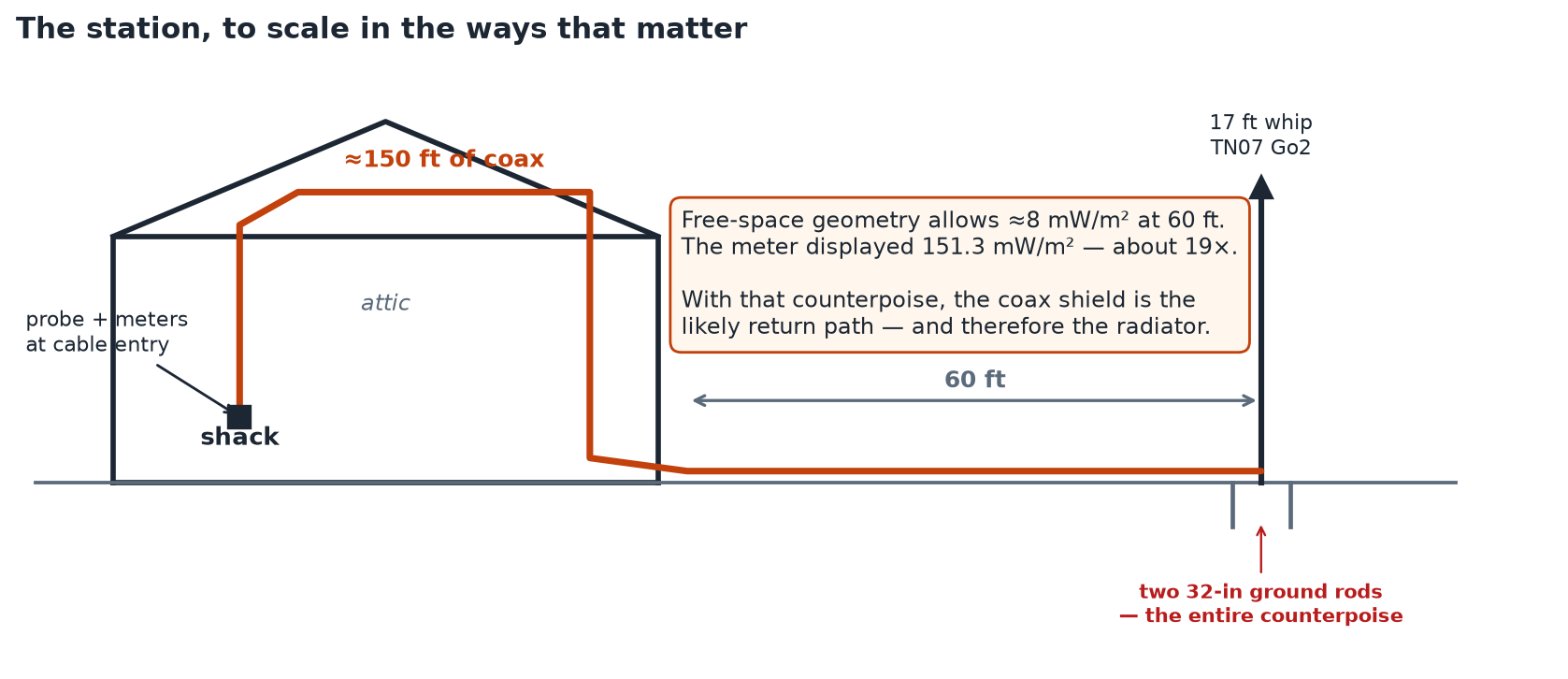
My antenna is a 17-foot whip about 60 feet from the shack, fed by roughly 150 feet of coax that runs up through the attic, across, back down, and out. Its counterpoise is a single 25-foot radial running about a foot off the ground, with two 32-inch ground rods supporting the whip and the wire.
Run the geometry: at 60 feet, my antenna should be putting somewhere around 8 mW/m² into the shack in free space. Less than that once you account for the walls in between.
That’s the shape of the problem. The in-band analog meter is deflecting sixty feet from the antenna, which is farther than the antenna’s own field should reach at any level worth noticing. And a single radial is an asymmetric ground — one wire on one side of the whip, not a symmetric field of them. That asymmetry is exactly the condition that puts current on the outside of the coax shield, which makes the shield the obvious candidate for the return path the radial isn’t fully providing.
Which would mean the thing radiating into my shack isn’t the antenna in the side yard. It’s 150 feet of coax running through my attic.
I want to underline that I haven’t measured this. It’s a hypothesis that fits every piece of evidence I have, and the way to test it is to clamp a current meter on the coax and transmit. That’s the next article, and I’ll report what it says even if it says I was wrong.
What this changes, and what it doesn’t
My conclusion hasn’t moved: at 40 watts on 15 meters, with the nearest person far outside four and a quarter feet, this station is well inside the limits. That was true when I started and it’s still true.
But I got there by a different route than I thought. The calculation was doing all the work. The meters contributed nothing except a needle that made me curious — which, to be fair, is exactly how this whole thing started and I’m glad it did.
If you take one thing from this:
- Do the evaluation. It’s required, it’s free, and it takes fifteen minutes.
- Don’t buy an EMF meter expecting it to check your work at HF. Read the frequency range before you buy — most start at 50 MHz and up, because they were built for WiFi.
- The number is probably less alarming than you expect. Four feet, at 40 watts. Look it up for your own station rather than carrying around a vague unease.
There’s more to this than one article — where those exposure limits actually come from, what the medical science does and doesn’t establish, and how to build an instrument that can measure what my meters couldn’t. Those are coming.
Two years ago I spent several hours chasing a problem that turned out to be an antenna switch set to the dummy load. Different failure, same lesson: the instrument in front of you is only telling you what it’s capable of telling you, and it’s worth knowing which is which.
73!
Verify you're not a bot to load comments: